The Shabbiness of Today’s Art Criticism
As a longtime art critic, and as the Senior Curator for the Riverside Art Museum, one would assume Peter Frank would know the difference between “Social Realism” and “Socialist Realism,” they may sound alike to those unfamiliar with art history, but Frank should know better. In his June 28th LA Weekly review of an exhibit of paintings by Armenian artist, Hagop Hagopian, Frank wrote:
“Born in Egypt, Hagop Hagopian returned to Armenia, his ancestral home, while it was still a Soviet republic. His decision to eschew Social Realist bombast for brittle, tender renditions of the local countryside cost him prominence, but endeared him to his countrymen.”
Frank has done a great disservice to the readers of the LA Weekly with his imprecise and erroneous use of the term, “Social Realist.” His inaccurate comment not only reveals an ignorance of art history, it also provides a perfect example of the shabbiness of today’s art criticism.
Social Realism in general refers to any realistic artwork that brings attention to the plight of the poor, the disenfranchised, or the working class—so in actuality Hagopian’s paintings, with their poetic references to the suffering of the Armenian people, could easily fall within the genre of Social Realism.

The modern American school of Social Realism got its start in early 20th Century New York, when painters like John French Sloan, George Bellows, and Robert Henri focused on painting canvases that depicted the lives of working people living in poor urban neighborhoods. Elite art critics of the day pejoratively referred to these painters as the Ashcan School, both for their mute color schemes and their insistence on painting the poor.
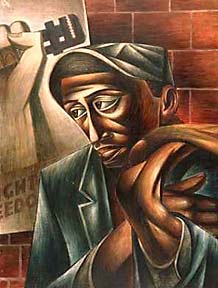
During the Great Depression of the 1930’s, a new crop of painters arrived on the scene who called themselves, Social Realists. Led by the likes of Ben Shahn, Reginald Marsh, and Raphael Soyer, the Social Realists were inspired by the Ashcan painters who preceded them, being devoted to portraying the real life experiences of working people. Motivated by a profound belief in art as a facilitator of social reform, Social Realism was actually an international style, with its most passionate adherents being the artists of the Mexican Muralist Movement.
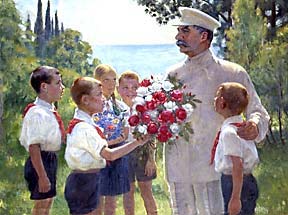
The genre Peter Frank meant to assail is the now defunct Socialist Realism of the former Soviet Union. In 1932 Joseph Stalin decreed Socialist Realism as the official art of the USSR, a diktat that led to Stalinist control over all artistic production.
The aim of Socialist Realism was to produce realistic works that not only extolled workers and the glories of communism, but called attention to the wisdom of the Communist Party and its leadership. Today, Socialist Realism is practiced nowhere outside of the People’s Republic of China (arguably) and North Korea.
Social Realism fell out of favor in the U.S. when abstract art became the in thing during the post-war period. Realism in general was viewed as passé by critics, curators and collectors, who all rushed to support avant-garde nonfigurative artists like Jackson Pollock, Willem de Kooning, and Mark Rothko. The anti-communism of 1950s America also diminished support for the Social Realists, who fell under suspicion for their social concerns.
However, figurative realists with social consciousness never entirely disappeared from the art scene, and today there is a resurgence in this type of work. As an art student I was inspired by the great Social Realists, Charles White, Diego Rivera, and Dorothea Lange, and as a painter who lives and works in the city of Los Angeles, I’m proud to carry the banner of Social Realism into the 21st Century.
I’m currently a participating artist in At Work: The Art of California Labor, an exhibit that presents the history of California’s workers through the eyes of artists. The show offers artworks created by Social Realists past and present, and if Peter Frank cares to visit… I’d be more than happy to walk him through the show to explain the differences between Social and Socialist Realism.