

Archaeology Awareness Playing Cards
During the 2003 U.S. invasion of Iraq, the Pentagon released to American troops a wanted list of Iraqi leaders that came in the form of a deck of cards. The playing cards featured photos and information about various government henchmen, and were designed to help U.S. troops identify and capture members of Saddam Hussein’s regime. Now, four years after the war began, the Pentagon has finally published a new set of cards – the Archaeology Awareness deck of playing cards. When the war began and American G.I.’s were hunting down members of the hated Baathist regime, the media made a great deal over the “Most Wanted” cards, but it’s not likely they’ll report much about the latest playing cards, for two important reasons; the Archaeology Awareness cards are about art, and it doesn’t exactly sound very gallant or heroic to have to council troops not to go about destroying a nation’s archaeological treasures.
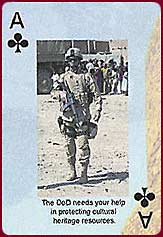
Back in February of 2005, I wrote an article titled Mesopotamia Endangered, detailing a damning report made by the British Museum of London regarding the widespread destruction of Iraq’s archeological sites by U.S. troops – so I have to say, at first I thought the Pentagon’s Archaeology Awareness cards seemed a classic case of “too little, too late” – especially when surveying the enormous war damage already done to Iraq’s historic sites. But then I read a news story about the new deck of cards in The Telegraph, and realized that the Archaeology Awareness campaign represents a long term operation. The Telegraph reported: “Archaeologists working at Ford Drum, New York, where troops are trained for deployment in Iraq, hope soldiers will know what to avoid when it comes to bivouacking or setting up gun installations.”
Yes, the Pentagon is now employing archaeologists to instruct troops on their way to Iraq on how to avoid damaging that country’s precious archaeological sites. The new deck of cards are part of that training, with each playing card depicting a different archaeological site or antiquity, along with tips on how to preserve them. The seven of clubs card pictures the Ctesiphon Arch in Iraq with the caption, “This site has survived 17 centuries. Will it and others survive you?” The two of clubs card pictures the Nabi Yunis Mosque in Mosul, along with the caption, “Ancient Iraqi heritage is part of your heritage. Old stories say that Jonah of the bible was buried in this hill.”
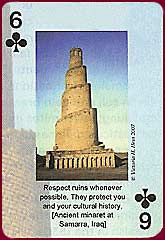
I don’t know whether to laugh or cry when thinking of young American soldiers learning about Iraq’s cultural treasures by way of a deck of playing cards. I suppose in the long run it’s a good policy, but maybe that’s what bothers me most, that it represents something unending – and there are many signals the U.S. intends to be in Iraq for a long time to come.
Of course, Iraq possesses the third largest oil fields in the world and the Bush administration is pushing for an Iraqi oil revenue-sharing law giving U.S. companies the lion’s share of profits. Major players in the Bush administration have been referring to a Korea model for Iraq’s future, alluding to the tens of thousands of U.S troops still stationed in South Korea 54 years after the end of the Korean war. In remarks made on June 18th, 2007, the top U.S. commander in Iraq, General Petraeus, said it may take “at least ten years” to defeat Iraqi guerrillas. And then there’s that new Vatican sized U.S. Embassy being constructed in Baghdad at a cost of $592 million, a gigantic sprawl covering the equivalent of 80 football fields. If I were a gambling man, I would bet that the dealer in the White House and his high stakes game in Iraq will all go bust – and I won’t need a new deck of cards to win that wager.