|
Purchase
Vallen's Poster
"NO HUMAN BEING IS ILLEGAL"
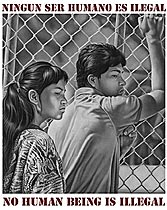 Bilingual Offset
Poster
Bilingual Offset
Poster
19" x 22" inches - $10.00
First published in
1988,
republished Aug. 2010.
|
|
|
|
|
|
| |
|
|
JUST
ANOTHER POSTER?
Chicano
Graphic Arts in California
Article
written by Mark Vallen, a participating artist in the exhibition,
in June 2001.
|
|
JUST
ANOTHER POSTER? - Chicano Graphic Arts in California,
is the first exhibition and book that explores the poster
art created by dozens of Chicano artists in California from
the late 1960s to the present. I am honored to be among
the artists included in this historic collection. Graphic
art has played a key role in El Movimiento (the Chicano
civil rights movement), and the poster has been used to
educate, agitate, and organize Americans of Mexican descent.
One could even say that political awareness and social activism
grew out of the Chicano arts movement.
Chicano
art has had many influences. Certainly Mexican artists like
José Guadalupe Posada, Frida Kahlo, and David Siqueiros
have had their effect, but so have American comic books,
Cuban political posters, and spray-painted barrio calligraphy.
|
|
|
|
Chicano
poster art became a means to help preserve and promote
a culture largely ignored by the dominant Eurocentric
society of the United States. Artists glorified Aztec
gods, Mexican revolutionaries, the Virgin de Guadalupe,
immigrant farm workers, and the experiences of everyday
raza (people.)
In
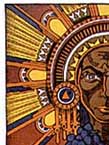
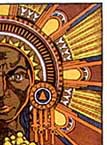
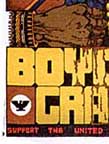
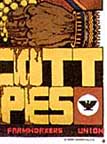
1973 artist Xavier Viramontes created the Boycott Grapes
poster shown directly above, one of the era's most famous
images supporting the United Farmworkers Union of César
Chávez. The poster at left, titled Rifa, was created
in 1972 by artist Leonard Castellanos (Rifa is Chicano
slang for "we rule" or "we're the best").
Both works portray Mexican icons, an Aztec warrior and
the revolutionary Emiliano Zapata, but each is reworked
to express a unique Chicano perspective.
|
|
Mexican
culture has always informed Chicano art, but it is the American
experience that truly gave birth to this distinct genre.
The Aztecs migrated from a mythical homeland called Aztlán
(Place of the White Heron), and many Chicanos see the Southwestern
U.S. as Aztlán, leading to the popular slogan, "We
didn't cross the border - the border crossed us!"
The
poster at right, Vietnam Aztlán, by artist Malaquias
Montoya, was created in 1972 and typifies the political
works in the show. The Chicano movement coincided with the
waging of the Vietnam War - and Chicanos who suffered from
discrimination, police brutality, and poverty at home, were
also dying in disproportionate numbers on the battlefield
of Vietnam. As a result, many embraced the anti-war movement.
Montoya's clear appeal for solidarity with the Vietnamese
people was shared by many Chicano artists of the day.
|
|
|
|
The
works of many artists and collectives appear in this exhibition
and book, including the artworks of The Royal Chicano Airforce,
Centro de Artistas Chicanos, Self Help Graphics, Yreina
Cervántez, Richard Duardo, Lalo Alcaraz, Willie Herron, Carlos
Almaraz, Rupert Garcia, and yours truly, Mark Vallen. There
are over 100 works of art from 50 different artists in this
exhibit and book. Many artists in the exhibition drew inspiration
from Mexican traditions like Dia de los Muertos (Day
of the Dead). The silkscreen print at left by Eduardo Oropeza,
created in 1984 and titled, El jarabe muertiano (Dance
of the Dead), pictures a typical festival of calaveras (skeletons).
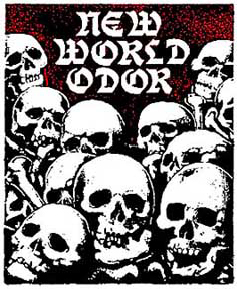
My contribution to the exhibition (shown directly below),
also refers to the celebration of the dead - but with a political
twist added. |
|
Rafael
Perez-Torres, Associate Professor of English at the University
of California - Los Angeles, wrote an essay for the book
in which he commented on my 1991 silkscreen, New World
Odor;
"The
title puns on the phrase President George H. W. Bush used
to characterize the sociopolitical configuration of the
world after the fall of the Berlin Wall and the Soviet Union.
The poster suggests this new order means nothing but the
same carnage beneath a different regime. The pile of skulls
tumbling toward the viewer presents a macabre, perhaps slightly
mocking version of what awaits us in a world dominated by
capital and commerce. The gothic lettering seems to reference
the poster art of the Third Reich, suggesting that the fall
of communism has ensured the triumph of fascistic forces.
The critique here is part of that strain in Chicano public
art concerned with political conditions at a global and
international level."
|
|
|
The
exhibition's beautiful, 218 page, bilingual book is filled
with artworks showing why Chicano poster art is so highly
regarded. I am proud to say that my New World Odor
poster is included in the volume and that my works are examined
in an essay by Carol Wells of the Center for the Study of
Political Graphics. Several authoritative essays by professors,
curators, and artists make this the indispensable book for
those who wish to understand the history and evolution of
Chicano graphic art. The book is available
online at Amazon.com.
Organized
by the University Art Museum - University of California
- Santa Barbara, in collaboration with the California Ethnic
and Multicultural Archives (CEMA), and the Center for the
Study of Political Graphics (CSPG), the show ran at the
UCLA Fowler Museum of Cultural History in Los Angeles
until December 9th. 2001. The exhibit has also been mounted
at the Oakland Museum of California, the Merced Multicultural
Arts Center in California, the Jersey
City Museum
in Jersey City,
New Jersey, and the
Crocker Art Museum and La Raza/Galería Posada in Sacramento
California, where the show ended on Sept. 14th, 2003.
|
|