|
2003:
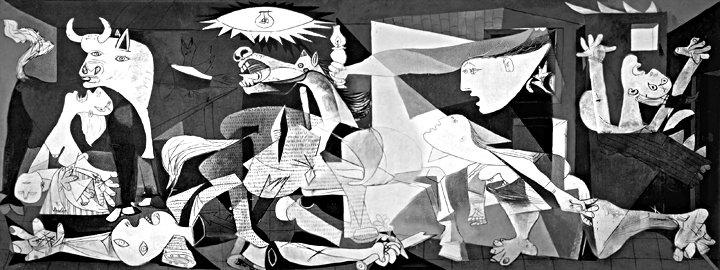
Pablo Picasso's "Guernica" censored at U.N.
I
wrote the following on February 5, 2003, just weeks
before the US attacked and occupied Iraq. I penned the
article on the day US Secretary of State Colin Powell
had appeared at the UN to argue Iraq possessed Weapons
of Mass Destruction and needed to be disarmed by force.
-- // --
As
a working artist I was deeply troubled to hear the following
news. The reproduction of Picasso's famous antiwar mural,
Guernica, hanging at the entrance to the UN Security
Council, was censored in January, 2003.
Picasso
agreed to paint a mural for the Spanish Pavilion of
the 1937 International World's Fair. Urged by representatives
of the Spanish Republic, then under siege by General
Franco and his Nazi allies, to paint something decrying
the fascist onslaught, Picasso was swayed by one particular
horrific incident. On April 26, 1937, Nazi war planes
obliterated the little Basque village in northern Spain
called Guernica. Hitler's forces pounded the village
from the air for hours, turning it into a sea of fire
and rubble. Over 1,600 civilians perished in the world's
first sustained aerial bombardment of a civilian population.
News
of the massacre reached Paris where Picasso was living.
Newspapers were filled with photographs of the smoldering
ruins of Guernica, and after having seen those photos
Picasso began working on sketches for a mural that was
to become one of his most famous works.
After
the World's Fair the mural was exhibited around the
world to help raise consciousness on the threat of fascism.
Once WWII began the mural was housed at the Museum of
Modern Art in New York, though it made frequent trips
abroad. Nelson A. Rockefeller had a large tapestry reproduction
made of the famous mural, and donated it to the UN in
1985. The original mural is now housed in the Reina
Sofia, Spain's national museum of modern art.
On
January 27, 2003, the Guernica reproduction hanging
outside the entrance of the United Nations Security
Council, was covered with a large blue curtain. Press
Secretary of the UN, Fred Eckhard, said the covering
provided "an appropriate background for the cameras."
Obviously
some were concerned that Picasso's antiwar masterwork
would not make a very good backdrop for speeches and
press conferences advocating the bombing and invasion
of Iraq. As the US talks about its "shock and awe"
strategy, the potential launching of over 800 Cruise
Missiles against Baghdad in two days, and its willingness
to use "bunker busting nuclear bombs" against
Iraq, Picasso's work is a chilling reminder of what
such military operations would mean for civilian populations.
On
Feb. 5th, 2003, US Secretary of State, Colin Powell
spoke before the United Nations to make his case for
a US attack on Iraq. Picasso's mural was completely
covered up and the flags of Security Council member
nations were placed before the censored artwork. As
Maureen Dowd, writing for the New York Times, wrote,
"Mr. Powell can't very well seduce the world into
bombing Iraq surrounded on camera by shrieking and mutilated
women, men, children, bulls and horses."
Australian
parliamentary representative Laurie
Brereton spoke before the Australian Parliament
on February 4th and said the following. "There
is a profound symbolism in pulling a shroud over this
great work of art. For throughout the debate on Iraq,
whether at the UN, in the US, or here in Australia,
there has been a remarkable degree of obfuscation, evasion
and denial, and never more so than when it comes to
the grim realities of military action."
The
censoring of Picasso's mural is illustrative of the
immense power of art. It is a civilizing force that
erases national boundaries and strengthens human solidarity.
In particular Picasso's masterwork continues to aim
a laser beam focus on the madness and inhumanity of
war, a message that transcends the barbarity suffered
by a small Basque village in 1937. As Picasso himself
once said, "Art is a lie that tells the truth."
The artist's profound mural still speaks the truth to
the people of the world, so much so that the powerful
feel compelled to censor it.
-- // --
This
article was updated on 4/25/2016, the 79th
anniversary of the bombing of Guernica.
www.art-for-a-change.com is owned and operated by Mark
Vallen ©
|