|
SIQUEIROS:
Portrait of Mexico Today
|
|
Essay
by Mark Vallen, published Nov. 2002. All photographs by
Mark Vallen ©
|
|
As
an artist long interested in the social and political
dimensions of art, few have influenced me as much as the
great Mexican artist, David Alfaro Siqueiros. Early in
my career, exposure to his profound works of social realism
not only inspired me to continue to pursue the path of
an artist, they also convinced me that art was a force
capable of changing the world. I
can happily say that the works of the great master are
as relevant as ever, and that his last surviving mural
in the U.S. was presented to the public by the Santa Barbara
Museum of Art on October 20, 2002. Along with thousands
of others, I attended the unveiling ceremony for Retrato
del Mexico de hoy ("Portrait of Mexico Today:1932"),
which is now in the museum's permanent collection and
on display in an alcove near the museum's entrance.
|
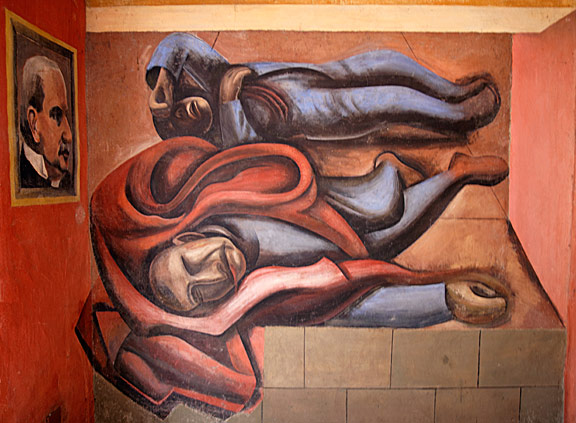 |
| Mexico
Today mural detail: J.P. Morgan overlooks the
slaughter of Mexican workers. |
|
Siqueiros
grew up in a Mexico filled with turmoil and class conflict.
He was a student radical and as a young man fought in
the revolution. He became a committed communist and a
union organizer and was repeatedly arrested for his efforts.
However,
the development of his political views went hand in hand
with the advent of his innovative aesthetics.
With
his contemporaries Diego Rivera and José Clemente Orozco,
Siqueiros put aside easel painting in favor of the democratic
public mural. Despite his standing as a highly regarded
artist he was eventually driven into a short exile because
of his leftist ideas.
|
|
Siqueiros
came to Los Angeles as a political refugee in 1932.
He stayed for six months before being unceremoniously
deported after his visa ran out. His arrival in the
U.S. came during the great depression when factories
closed and thousands were thrown out of work. While
in L.A. he painted three important murals. The first,
Mitin
Obreo ("Worker's Meeting") was created
at the prestigious Chouinard School of Art. Siqueiros
had been invited by the school to teach a class in mural
painting, and what better way to educate his students
than to directly involve them in the creation of a mural.
The 20 by 30 foot painting was on an outside wall of
the school.
Mitin
Obrero depicted a militant union organizer and the
multi-cultural crowd of workers who had put down their
tools to listen to his oration. The authorities almost
immediately covered the painting with a tarp to prevent
public viewing and within a year it was completely destroyed.
The
mural represented a great advancement in art making
in the U.S., it was one of the first outdoor murals
to create a public space on the street. It was also
the very first time in the U.S. that an artist had used
a projector to transfer enlarged images to a surface,
or to use a mechanized spray gun to apply paint. This
was a technique developed by Siqueiros.
|
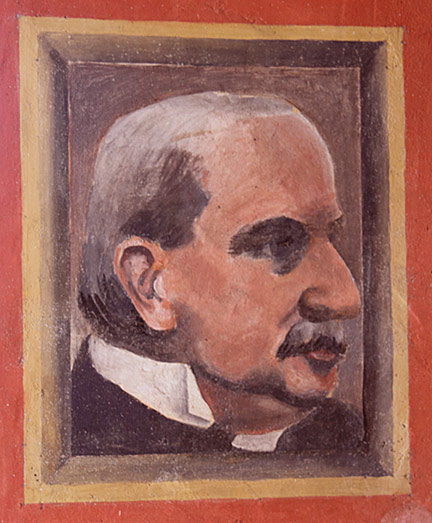 |
| Mexico
Today mural detail: American capitalist J.P.
Morgan |
|
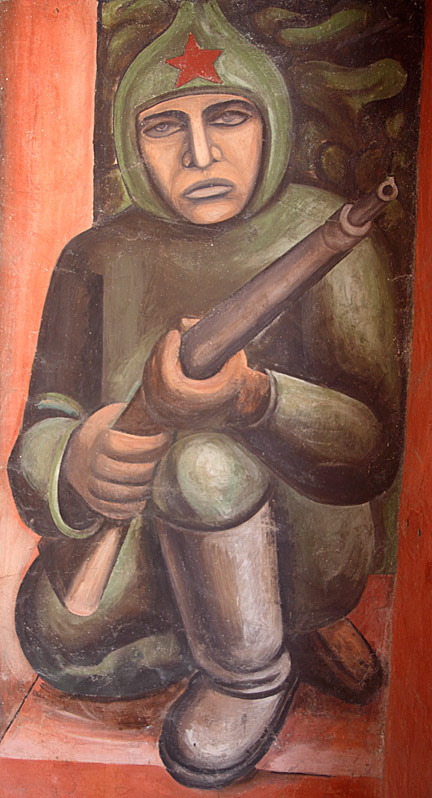 |
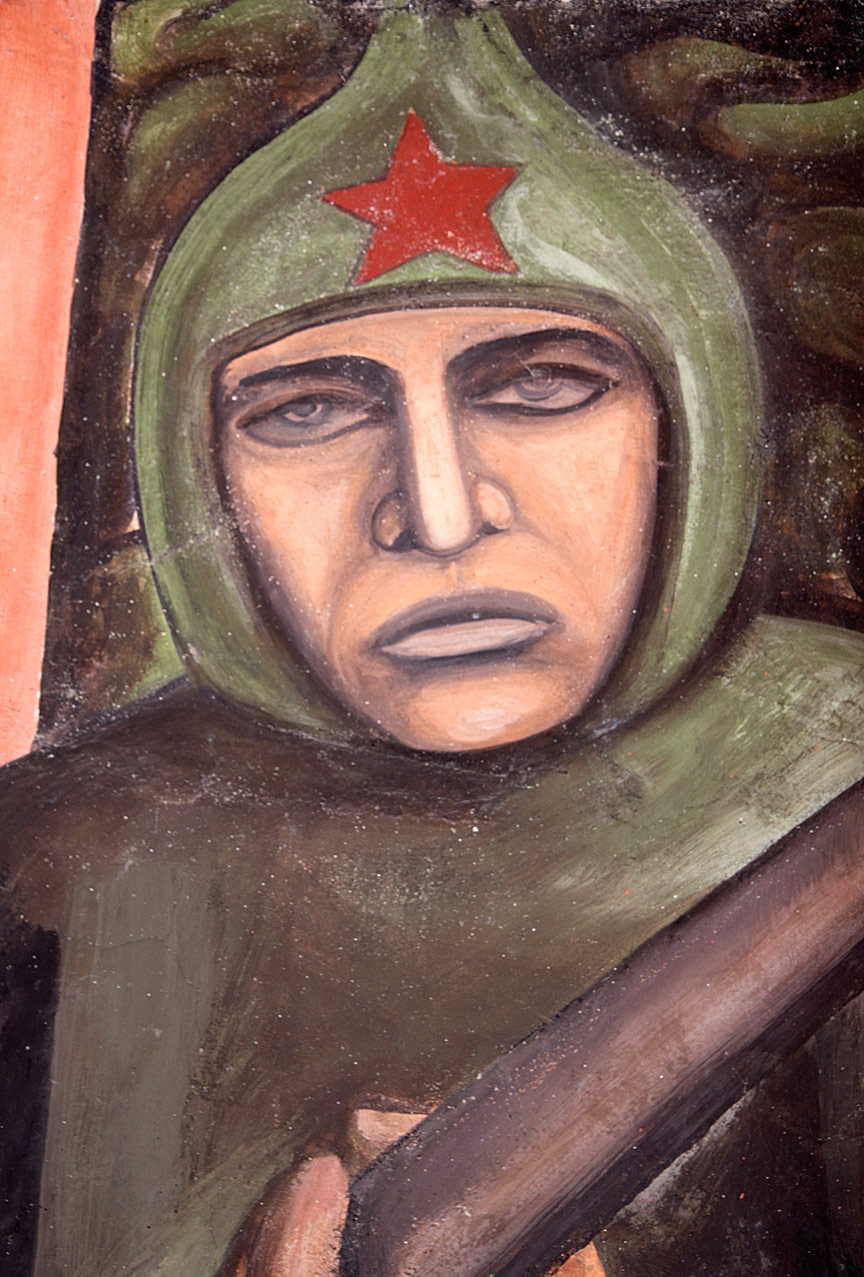
| Mexico
Today mural detail: Red Army soldier. |
|
The
second and most famous of Siqueiros' L.A. murals,
América
Tropical, was
painted on a rooftop overlooking the City's historic
Olvera Street. The Plaza Art Center wanted the artist
to paint an exotic picture of Latin America replete
with tropical birds and lush jungle. Instead Siqueiros
covered the 130 foot wall space with a terrifying
visage. The mural's central focus was an Indian crucified
on a cross, on top of which sat the eagle of imperialism.
The
background consisted of ruined Indian pyramids, a reference
to the European sacking of indigenous grandeur. To
the left and right of this scene, armed peasants were
coming out of the jungle to wage a war of liberation.
Once
again Siqueiros used a projector to transfer his images
to the wall, and a spray gun to paint the mural. Needless
to say, conservatives were outraged over the artwork
and authorities had it immediately whitewashed. It sat
abandoned for decades until the J. Paul Getty Museum
decided to restore it.
The
artist's third mural in Los Angeles, Portrait of
Mexico Today: 1932, had better luck. Film director
Dudley Murphy was a great supporter of Siqueiros, and
to show his appreciation the artist painted a mural
at the director's Pacific Palisades home. Luckily for
us all, the 170 square foot work was donated to the
Santa Barbara Museum of Art in 2001.
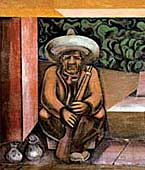
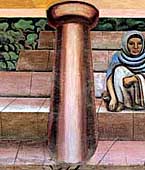
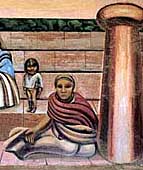
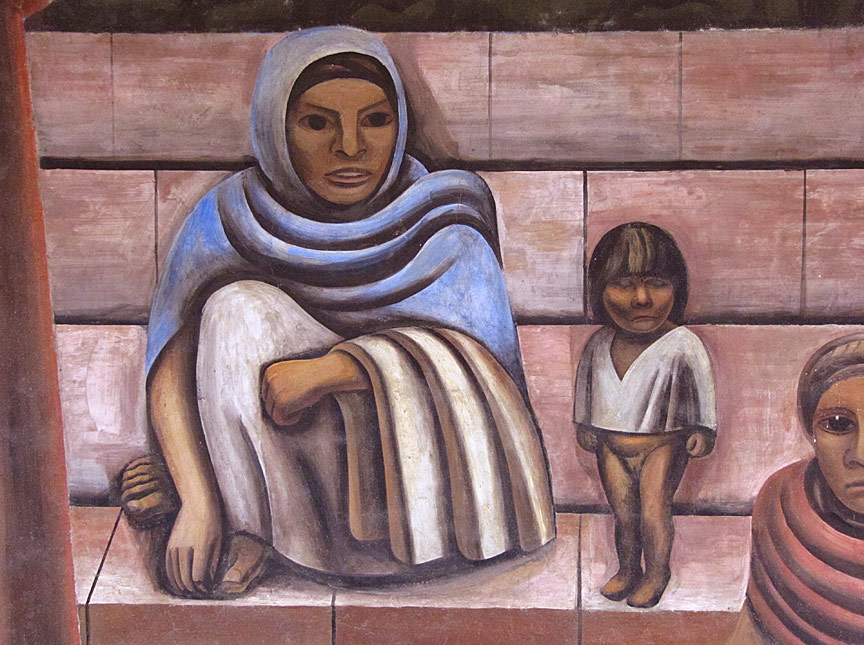
Situated
in a semi-enclosed garden structure, the mural depicts
two impoverished peasant women with a partially clothed
child standing between them. The trio are placed on
the steps of an ancient Indian pyramid surrounded by
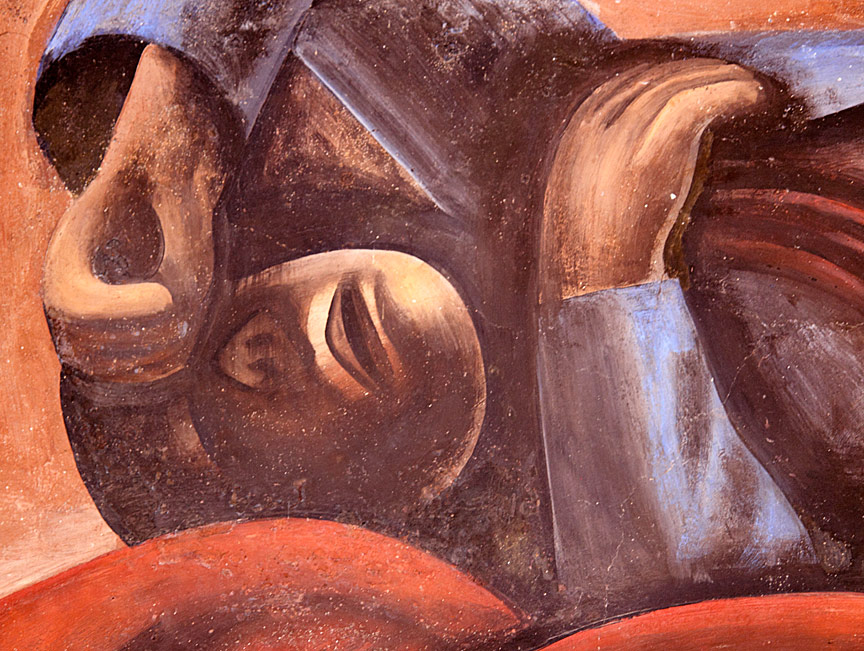
jungle. To the extreme left of this scene are the bodies
of two slain workers, blood trickling from their mouths.
Overlooking
the slaughter is a portrait of the American capitalist,
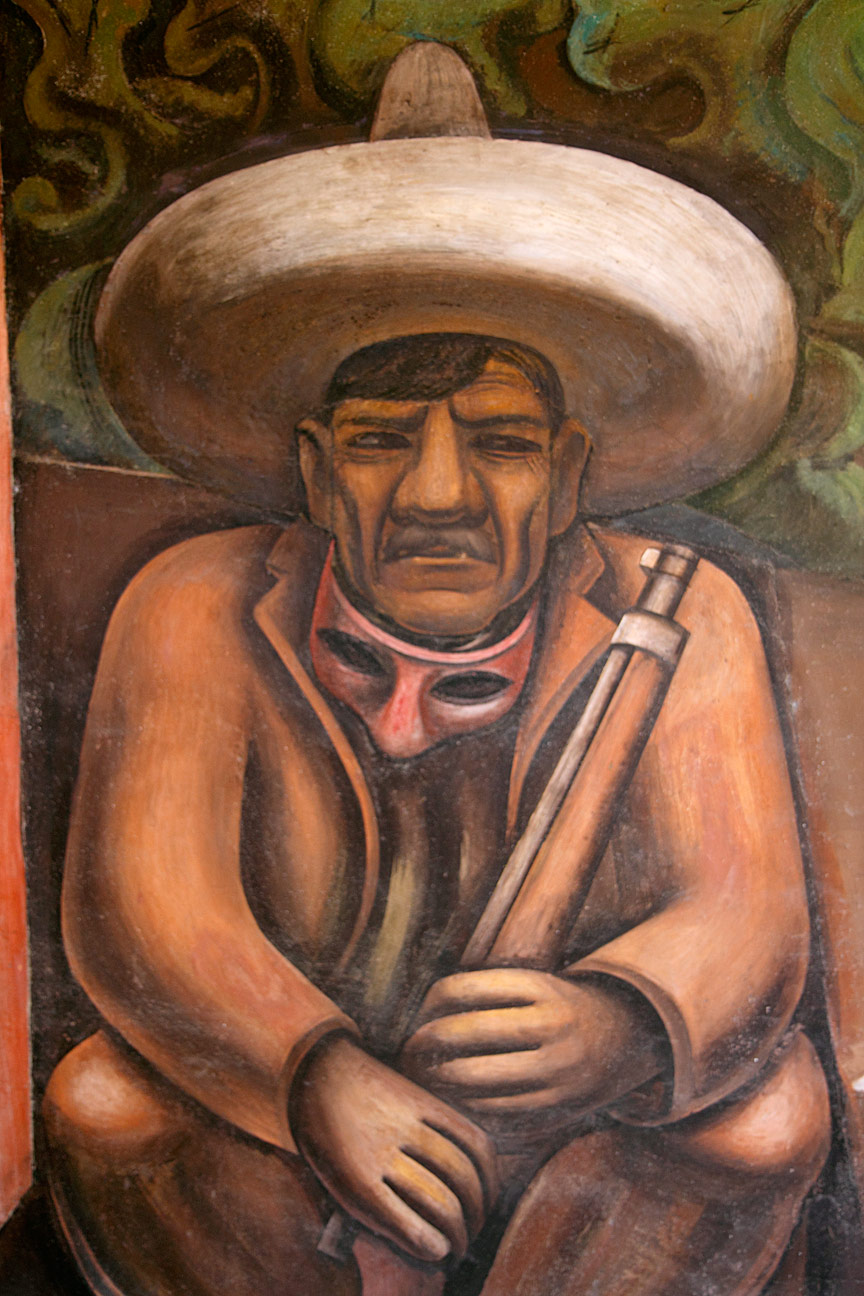
J.P. Morgan. Close by and under the gaze of the approving
Morgan, sits the Mexican President, Plutarco Elías Calles.
Shown as an armed bandit with stolen money bags at his
feet, Calles is portrayed as an errand boy to the foreign
masters of El Norte. At the opposite end of the mural
crouches a communist soldier bearing a rifle, representing
the forces that would forever end the oppression of
the workers; the soldier bears a striking resemblance
to Siqueiros.
|
|
Siqueiros
passed away in 1974, never having achieved the recognition
in the U.S. that he so richly deserved, until the Santa
Barbara Museum of Art honored him with a community celebration.
October 20th, 2002 was a milestone for freedom of expression,
but it was also a great day for art and a vindication
for those artists whose works reflect a social consciousness.
While
dozens of luminaries from the world of art, commerce,
and politics were part of the ceremony (including the
Mayor of the city of Santa Barbara and a representative
from the Mexican government), it was the thousands of
ordinary people who attended the unveiling that served
as the highest tribute to the revolutionary artist.
People thirst for art that reflects their reality, history,
and aspirations, and today's artists must rediscover
the path blazed by David Alfaro Siqueiros.
|
|
|
| Mexico
Today mural detail: Dying Mexican Worker. Photo by
Mark Vallen © |
|
|
| Mexico
Today mural detail: Mexican campesino family. Photo
by Mark Vallen ©
|
|
|
| Mexico
Today mural detail: The bandit president, Plutarco
Elías Calles. Photo by Mark Vallen ©
|
|
|
| Mexico
Today mural detail: "a communist soldier bearing a
rifle, representing the forces that would forever end
the oppression of the workers." Photo by Mark Vallen ©
|
|
|
Philip
Stein, a.k.a. Estaño, wrote the definitive biography
on Siquieros, Siqueiros, His Life and Works.
Estaño (1919-2009) was a tremendously talented painter
who worked with Siquieros in Mexico for some ten
years, helping the master to create some of his
most renowned murals. The 400 page book provides
incredible insights into the work, life, and times
of one of the world's greatest political artists.
The book includes 72 pages of color and black and
white artwork reproductions, as well as historic
photographs.
Available on amazon.com |
|
|