| |
|
|
Salvador
Dalí - Avida Dollars
Article
by artist Mark Vallen. February 2005
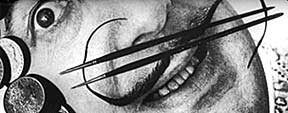
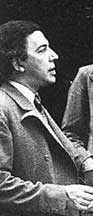
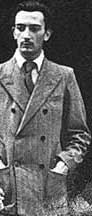
Photo of Dali by Philippe Halsman. |
Starting
February 12th and running until May 15th 2005, the
Philadelphia Museum of Art will present DALÍ,
a broad retrospective of the artist's works - the
first in the United States in over 60 years. Co-curator
of the exhibit, Michael Taylor, said "It's astonishing,
the range of his work. It's really crucial, I think,
to the re-evaluation of his career." As the media,
historians, and art critics have another look at
Dalí, it is indeed time for a new examination of
the artist's life.
|
|
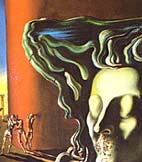
As
a nine year old in 1963, I cracked open an art book
presenting the works of Salvador Dalí, and became
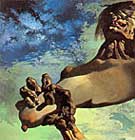
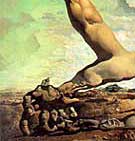
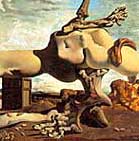
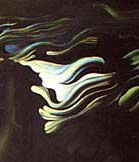
transfixed by his 1936 painting, Soft Construction
with Boiled Beans -Premonition of the Spanish Civil
War. The bizarre painting of a grotesque monster
pulling itself apart refused to convey any meaning
to me whatsoever, yet I was spellbound by the image.
It was one of those formative moments in life when
I knew providence would make me an artist. As I
matured so too did my fondness for the surrealist
painter, and by sixteen I had developed a full blown
obsession with Dalí's works. A few years later,
as I turned to reading history, I discovered that
Soft Construction with Boiled Beans was not
a premonition, and that my idol was not the founder
of surrealism.
|
|
|
|
Soft
Construction with Boiled Beans -
Dalí 1936
|
|
|
I
was surprised to learn about the original 1924 Parisian
surrealist group (to which Dalí was admitted in
1929). Founded and led by the French writer André
Breton, the group included members like Max
Ernst, Joan
Miró, and Yves
Tanguy. The surrealists had as their goal the
total revolutionary transformation of society. They
believed the subconscious was the wellspring of
a liberated art, and they refused any restraints,
whether brought to bear by reason, aesthetics, or
morality. Dalí was influenced by surrealism in 1924
after exposure to La Révolution Surréaliste,
the journal edited by André Breton. Dalí put aside
his early cubist approach and took up the banner
of surrealism. He collaborated with friend Luis
Buńuel in creating the film, Un Chien Andalou
(An Andalusian Dog). The surrealist movie premiered
in Paris 1929 and received a standing ovation from
an audience composed of Pablo Picasso, Jean Cocteau,
Fernand Leger, Tristan Tzara, and the entire surrealist
entourage. Soon after Dalí and Buńuel were inducted
into the surrealist circle, and Dalí's early years
in the group were rewarding. But by the late 30's
his creeping ultra-conservatism caused him to fall
out of favor with his fellow artists, and he was
ultimately expelled as a renegade in 1939.
|
|
|
|
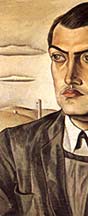
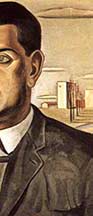
Luis
Buńuel by Dalí, 1924.
|
|
|
When
referring to André Breton's eventual criticism of
Dalí, the Philadelphia Museum's promotional material
makes it sound like a case of mere professional
jealousy. "Breton
had long thought Dalí's art had become too commercialized
and that Dalí's growing fame threatened the unity
and agenda of the surrealists. His growing disgust
with Dalí's financial success as an artist led him
to dub Salvador Dalí with the anagrammatic nickname
"Avida Dollars," describing what
he perceived as Dalí's greed for money and fame.
Though no longer associated with the Surrealists,
Dalí never abandoned his Surrealist pursuits entirely."
|
|
André
Breton's disapproval of Dali had nothing
to do with the Spanish painter's "financial success,"
rather, it was an issue of political integrity.
Breton had an excellent relationship with the Mexican
Muralist, Diego Rivera, who enjoyed financial success
and the largesse of wealthy patrons while continuing
to develop a revolutionary art.
|
|
Dalí
on the other hand immigrated to the US to sit
out the war years and pursue a capitalist-style
career. He lived in America from 1939 to 1948,
where he became a master of exhibitionism and
self-promotion. He was the darling of advertisers,
who used him to sell every imaginable product.
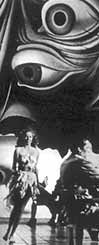
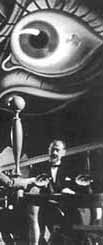
He worked for Disney and created a
cinematic sequence for Alfred Hitchock's, Spellbound.
His meticulously cultivated flamboyant persona
and thoroughly orchestrated eccentricity guaranteed
a public perception of him as the ultimate surrealist
artist - it also brought him a personal fortune
estimated at over $30 million dollars. Breton
was not off the mark in bestowing upon Dalí the
anagram of Avida Dollars ("Greedy
for Dollars"), in fact Dalí was so venal
when it came to wealth that he enthusiastically
embraced
the anagram as a nickname.
|
|
|
|
Breton
(left) and Dali, circa 1929
|
|
|
|
|
Dalí's
set design for
Alfred Hitchock's, Spellbound.
|
|
|
But
surrealist ire towards Dalí had less to do with
his greed, and far more to do with his dubious
political opinions. War and fascism were on Europe's
horizon, and thesurrealists moved further to the
left when the Nazis seized absolute power in 1933
and Germany began its decent into barbarism. Hitler
initiated an unprecedented campaign of terror
- civil rights were no more, artists and intellectuals
began to flee the country, book burnings had begun,
more than 25,000 communists, socialists, and Jews
had been sent to concentration camps - and that
was just the beginning.
Tensions
developed within the surrealist group as Dalí
evaded anti-fascist political ideas and actions
and instead showed an obsessive interest in what
he called the "Hitler phenomenon." As Dalí's infatuation
with Hitler grew, he came under suspicion by his
fellow surrealists.
|
In
1933, instead of condemning Hitler, Dalí painted
and exhibited
The Enigma of William Tell, a semi-nude
portrait of Lenin with a huge anamorphic buttock.
The surrealists saw the painting as a provocation
- especially since the Nazis were busy murdering
people for being "communists." Dalí defended himself
by saying, "No dialectical progress will be possible
if one adopts the reprehensible attitude of rejecting
and fighting against Hitlerism without trying
to understand it as fully as possible." Surrealist
misgivings concerning Dalí's political loyalties
led him to sign a declaration that he "was not
an enemy of the proletariat," but the situation
only worsened with the outbreak of the Spanish
Civil War. In 1936 General Franco's Nazi-supported
troops led a revolt against the democratically
elected government seated in Madrid.
|
|
While
the surrealists and artists worldwide reacted
to the outrages of fascism against the Spanish
Republic, Dalí painted his Soft Construction
with Boiled Beans (shown at the top of this
essay). It was a work that many art critics have
mistakenly construed as being "antiwar."
Commenting
on the canvas, the Philadelphia Museum's promotional
material states, "Though
Dalí intended this painting as a comment on the
horrors of the Spanish Civil War, he did not openly
side with the Republic or with the fascist regime.
In fact, the painting is one of only a few works
by Dalí to deal with contemporary social or political
issues. Unlike other Spanish modernists, including
Pablo Picasso and Joan Miró, who used their art
to make political statements in support of the
Spanish Republic, Dalí preferred
to remain apolitical."
|
|
The
co-curator of the Philadelphia Museum exhibit,
Michael Taylor, said that Dalí "wants the Spanish
Civil War to be seen as a really monstrous thing
that's ripping the country apart. He didn't want
to take sides. I think Picasso wanted to take
sides." Thank goodness Pablo Picasso took sides!
The Condor Legion was a unit of the Nazi air force
or Luftwaffe, created by Hitler to assist Franco.
On April 26, 1937, German Condor Legion bombers
attacked the ancient Basque village of Guernica,
killing nearly 2,000 people in history's first
arial mass bombing of a civilian population. Picasso's
response was to paint a masterwork, Guernica,
perhaps the 20th century's greatest antiwar painting.
|
|
|
How
could one not have taken sides when Mussolini's
tanks and Hitler's air force assisted Franco's
troops in extinguishing democracy in Spain? It
is a fallacy to think Dalí "remained apolitical"
while Spain was cut to ribbons by fascist bayonets.
Silence sometimes masks complicity, but Dalí
pledged his full and unwavering support for the
fascist dictatorship of Francisco Franco.
That
pledge to Franco resulted in Dalí being thrown
out of the surrealist movement for good, but his
1939 painting The
Enigma of Hitler
(which now hangs in the Museo Nacional Reina
Sofia, Madrid) also contributed to his expulsion.
Dalí had inserted a small portrait of Adolph Hitler
in the barren surreal landscape.
|
|
The
prior year had seen the whirlwind of anti-Semitic
hatred known as Kristallnacht (Night of
Broken Glass) explode in Germany. Hundreds of
Jewish synagogues were torched, thousands of Jewish
businesses were looted, and 30,000 Jews were sent
to the concentration camps of Dachau, Buchenwald,
and Sachsenhausen. Against that appalling backdrop
Dali dared to portray Hitler as an "enigma." The
surrealists could no longer put up with Dali's
conduct and decided to expel what they considered
a reactionary impostor from their ranks.
|
|
Eventually
Dalí returned to Franco's Spain after the war,
and it no doubt endlessly pleased the dictator
to have the celebrated artist living and working
there when few other well-known personalities
would. Dalí announced his conversion to traditional
Catholicism, and the sacred art he created in
the 1950's became some of his most popular works
worldwide. Long gone was Dalí the rebel anticleric,
the scatological genius, the anarchistic surrealist.
But
even his religious paintings, surreal Madonnas
and crucifixion scenes, seemed tainted inasmuch
as they were the type of artworks fully sanctioned
by the fascists who lorded over Spain. After having
overthrown the duly elected government, General
Franco ran Spain with an iron fist until his death
in 1975. The country's first democratic elections
since 1936 were held two years after Franco's
demise. Salvador Dalí passed away in 1989, at
the age of 85.
|
|
|
|
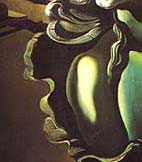
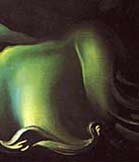
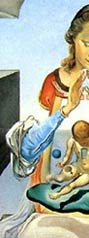
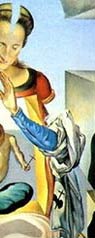
Madonna
of Port Lligat
1949 (detail)
|
|
|
I
write these words not as a detractor of
Dalí's works, but as someone opposed to the revisionism
surrounding his history. To be honest, I still
admire Dalí as an accomplished painter, and I
find genius in the works he produced throughout
his long career. But one must be honest about
Dalí's considerable flaws in order to properly
re-evaluate his contributions to art. The Philadelphia
Museum does a disservice to its patrons and to
history by asserting "Dalí never abandoned his
Surrealist pursuits entirely."
Surrealism
was always much more than a decorative fantasy
art composed of bizarre landscapes filled with
melting watches. It was a complete philosophical,
political, and aesthetic program that by the late
30's had been entirely discarded by Dalí. The
year 2004 was celebrated as the 100th anniversary
of Salvador Dalí's birth. The chairman of Spain's
Dali Year Commission stated in 2004 that
if Pablo Picasso (who was a communist), received
"international acclaim, then Dalí, who admittedly
supported fascism in Spain, should receive his
own homage." In light of such a statement, it
is astonishing that the Philadelphia Museum of
Art can still say that Dalí "preferred to remain
apolitical."
|
|
|