|
Free downloadable
11 x 17 inch poster
"AYOTZINAPA
SOMOS TODOS"
(We
are all Ayotzinapa)
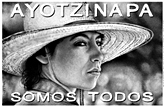
Created by Los Angeles artist Mark Vallen in support of the
43 kidnapped students of Ayotzinapa, Mexico.
Publish the posters on any printer that takes
11 x 17 inch paper, and help spread the word...
We are all Ayotzinapa!
Download in .pdf format
2 megabytes
Download in .jpg format
23
megabytes
Read
about the creation of the poster
|
|
| |
|
|
N O
P A S A R A N !
Posters
of the Spanish Civil War - Essay by Mark Vallen
|
|
Click
the thumbnails for the full picture
|
|
|
It
is within the context of war and revolution that the
posters presented here must be seen. They became important
weapons in the battle for a free Spain. Political parties,
organizations and trade unions used the posters to communicate
with the people, large segments of which were illiterate.
The posters were present everywhere, they spoke from
the battalion stations and trenches to the home and
office. They were put up on telephone polls, walls,
buildings, and every available space in cities and towns.
In
July 1936, the opening shots of the 2nd World War were
fired in Europe's poorest country... Spain. Long governed
by a wealthy elite and its brutal military police (the
infamous Guardia Civil - Civil Guard), the people saw
their chance for democracy in the collapse of the 13
year old dictatorship of General Primo de Rivera.
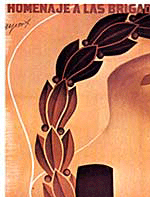
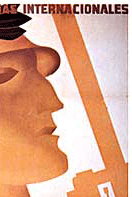
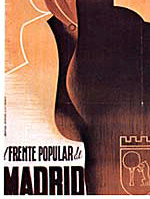
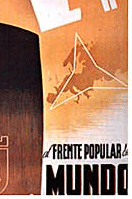
(Left)
"Homage To The International Brigades - From the
Popular Front of Madrid to the Popular Front of the
World." Artist, Espert
|
|
When
elections were held and the monarchist candidates defeated
at the polls, King Alfonso XIII left Spain for exile in
Italy. On April 4, 1931, the Provisional Government of
the Republic of Spain was proclaimed to wildly enthusiastic
crowds. To a nation long victimized by malnutrition, illiteracy,
unemployment, mass arrest and torture, these were heady
days of freedom. Social democrats, intellectuals, peasants,
workers, artists, labor unionists, communists, socialists,
anarchists... all intoxicated with the idea of a new society,
worked tirelessly towards a Spain free of grinding poverty,
privilege and cruel repression.
|
|
When
the new republican government set about the task of modernizing
and reforming Spain, class conflict erupted. To breakup
the great estates of the rich and give the land to the
landless peasants was regarded by the wealthy as an attack
on property rights. Improving the conditions of those
who worked in factories, shipyards and mines was seen
by capitalists as a threat to profit. Giving autonomy
to Catalonia was for the right-wing nationalists the tearing
of Spain to tatters. Removing the privileges of the enormously
wealthy Catholic church was seen by conservative Catholics
as the "dechristianization" of the country.
Moves
to reduce the overblown officer corps created animosity
against the government from within the army. Ultimately
these conservative social forces sought salvation and
the restoration of "order" by launching a military coup.
The aim of the army rebellion led by General Franco and
his nationalist movement was the crushing of the republican
government in Madrid, but instead this treason was met
with popular armed resistance. The civil war began in
earnest. Franco's
nationalist movement had powerful allies in the fascist
regimes of Germany and Italy. Without the combined military
might of these two dictatorships aiding Franco, his dreams
of destroying the Spanish republic would have failed.
The first airlift in modern war occurred when Nazi planes
transported Franco's troops to battle. Italy sent airplanes,
tanks, trucks and some 47,000 ground troops. Nazi planes
conducted the first saturation bombing of a defenseless
civilian target when they obliterated the town of Guernica.
The
great powers of the west did nothing while Spain was being
ravaged. There was tacit approval in this silence as the
young republic was cut apart by fascist bayonets. However,
people from all over the world came to the aid of Spain.
Artists were in the forefront of this International outpouring
of sympathy. Ernest Hemingway, George Orwell, Paul Robeson,
Pablo Picasso and Joan Miro are but a few of those
who lent their talents to the republican cause. Volunteer
brigades came from every corner of the globe to defend
Spain as combatants, the Abraham Lincoln Brigade from
the United States being the most well known of these (members
of the Abraham Lincoln Brigade would later be persecuted
in the United States for being communists and "premature
anti-fascists").
Some
of the posters presented on these pages were created anonymously
while others were produced by the Spanish Artist's Union,
who infused the most vigorous experiments of the time
(Expressionism and the Constructivism of Soviet artists),
with the simplicity and directness that are the traditions
of the revolutionary message. The artists, printers, lithographers
and those who distributed the works labored under the
perilous conditions of air raids and artillery fire. Faced
with shortages of materials and an inadequate supply of
electricity for light and printing presses, they nevertheless
managed to create powerful works that still reverberate
in our time. The internal pressures of disparate ideologies
working together in coalition, the vicious onslaught of
the fascist armies, plus the blockade imposed upon the
young republic by the west, led to the demise of the revolution.
Yet even in defeat, the posters presented here continue
to tell of the implacable fight for true freedom and democracy.
|
|
www.art-for-a-change.com
is owned and operated by Mark Vallen © All text by Mark
Vallen.
|
|